The Standing Committee on Agricultural Research (SCAR) is a comitology body of the European Commission (EC) originally established in the 1970s. Comitology refers to a set of procedures, including meetings of representative committees, that give European Union (EU) countries a say in the implementation of EU law.
SCAR’s remit lies in the area of agriculture, fisheries, food, forestry and the wider bioeconomy, with a focus on research and innovation (R&I). Its main task is to provide strategic R&I policy advice in this domain, helping to create an integrated European Research Area (ERA).
It is a key platform for creating Horizon Europe Partnerships, which address some of Europe’s most pressing challenges through concerted R&I initiatives.
How is SCAR organised, what are its goals and who are its members?
BUILD THE FUTURE RESEARCH AGENDA
The SCAR Working Groups form an inspiring network of motivated peers. They offer unique platforms to develop R&I agendas, co-construct European R&I partnerships, and exchange experiences and best practices. Moreover, being a member of the SCAR helps delegates and scientists implement national research priorities at the European level, and helps align national and European R&I agendas.
ARE YOU...
…already a member of the SCAR community, and interested in helping it grow? Take up an active role in the Working Groups or Plenary Meeting, motivate your research community to join the SCAR Working Groups, and disseminate the results in your country to increase the SCAR’s impact.
…a scientist, eager to meet peers to exchange knowledge and learn from them? Contact your country’s SCAR delegate and request to join one of the Working Groups.
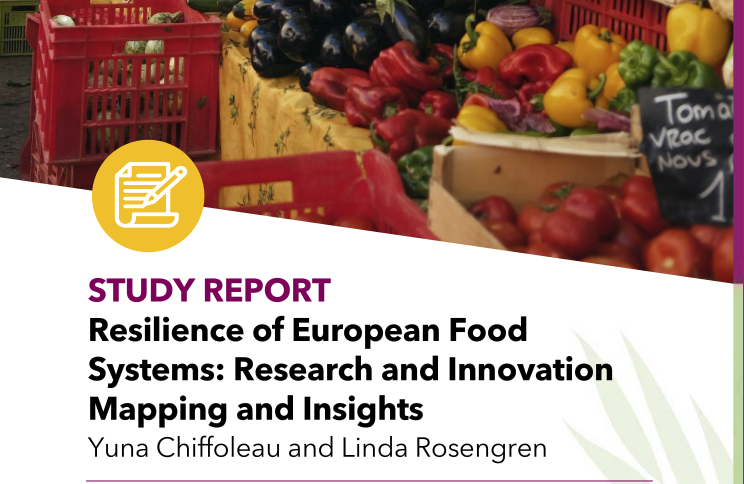
The SCAR Food Systems Working Group, with the support of RefreSCAR, has published a new study report titled 'Resilience of European Food Systems: Research and Innovation Mapping and Insights', authored by Yuna Chiffoleau and Linda Rosengren.
Resilience has become a defining theme in research, innovation and public policy against a backdrop of multiple and interlinked crises. This report maps and analyses R&I on food system resilience over the past decade, drawing on a systematic review of 163 projects, an online survey and five case studies.
The findings reveal a marked increase in food system resilience R&I since 2015, but also a significant imbalance: most projects focus on...
New report from the SCAR Animal Health & Welfare Working Group
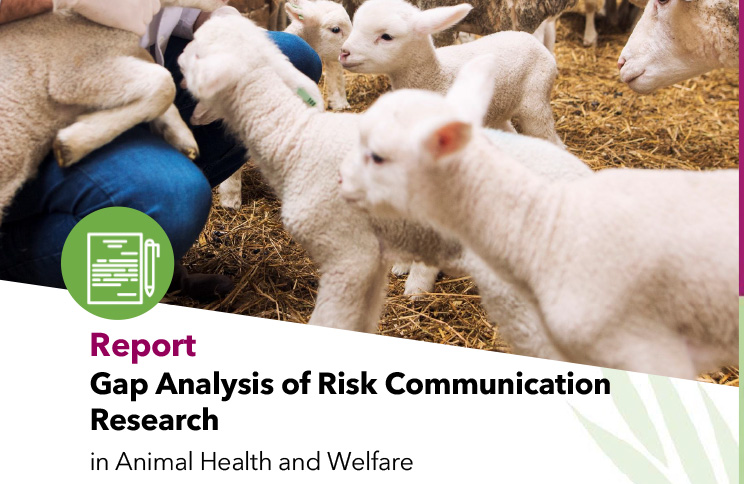
The Animal Health & Welfare Working Group have just published their new report titled on 'Risk Communication in Animal Health and Welfare'. This report was funded by RefreSCAR and led by Satu Raussi and Tiina Kauppinen from Natural Resources Institute Finland / Luonnonvarakeskus.
The main objective of this study was to develop actionable recommendations for enhancing risk communication strategies within the context of animal health and welfare.
The report includes three separate analyses of gaps and existing knowledge of current research...
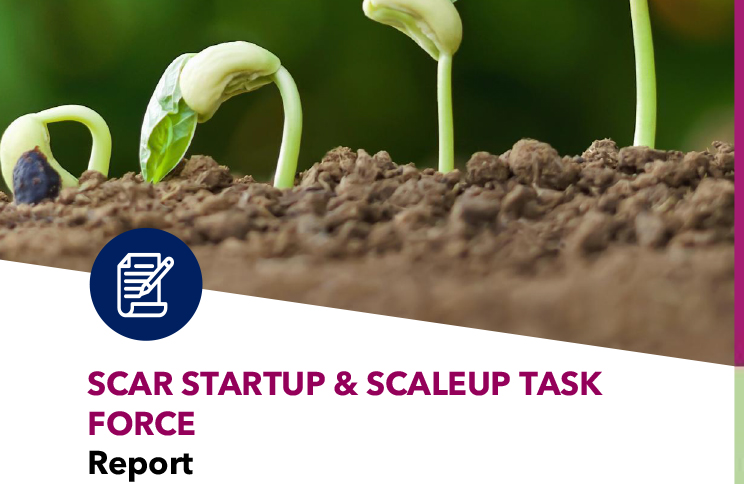
The SCAR Startup and Scaleup Task Force, established at the request of the European Commission, has just published its final report on how Research and Innovation can better support startups, scaleups and innovation-driven businesses across agriculture, forestry, rural areas and food systems.
The report draws on evidence from 49 case studies across EU Member States and identifies a clear message: Europe has a strong R&I base and significant entrepreneurial potential, but persistent barriers continue to limit the translation of innovation into scalable market deployment.
To address this, the Task Force puts forward six strategic recommendations, with a focus on...
📢 SCAR Animal Health & Welfare WG has two new publications on regulatory science for farm animal welfare are (R&I Analysis Report and Practice Brief) with actionable recommendations for researchers, policymakers and funders👇
— RefreSCAR (@RefreSCAR_) July 8, 2026
📘https://t.co/d78ccbrpS6
📄https://t.co/ZZv84kdiba pic.twitter.com/TYQ6o2l9uu
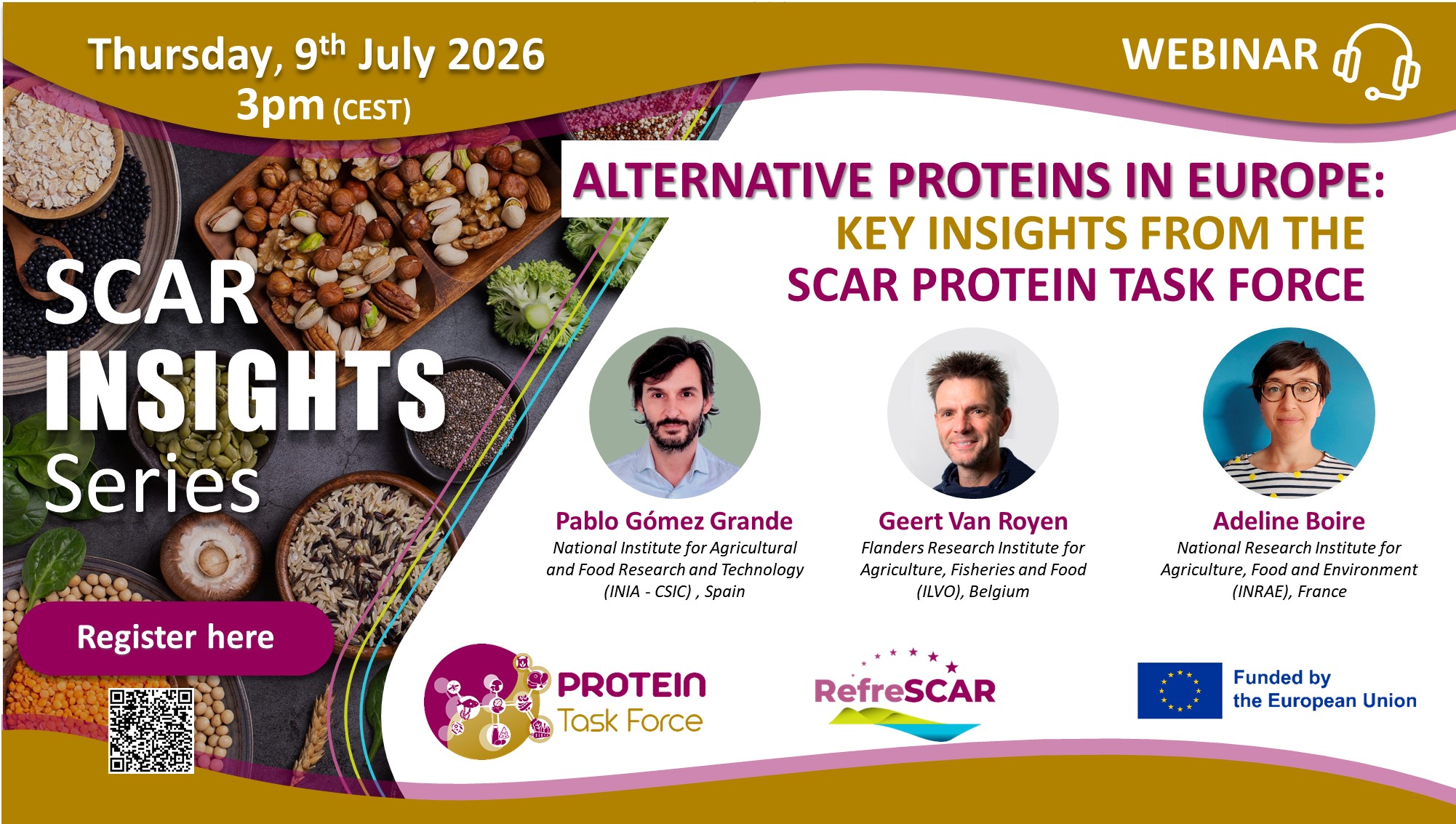
The third edition of the SCAR Insights webinar series, as part of the RefreSCAR project, took place on July 9th at 2 PM (CEST). Representatives from the SCAR Protein Task Force shared important information on protein production and consumption in Europe, EU-funded research on alternative proteins, and the main challenges and opportunities identified throughout the Task Force's work.
PROGRAM:
Pablo Gómez Grande - SCAR Protein Task Force Scope and Context of protein production and consumption in Europe
Geert van Royen - Portfolio analysis of EU projects funded on alternative proteins: gaps, challenges and needs
Adeline Boire - Challenges and opportunities identified through the Protein Task Force's work
| ||||||||||||||||||||||||||||||||||||||||||||||||||||
| 29 Sep 2026 Workshop on ruminants and greenhouse gases |