01.01.2025 – 31.12.2026
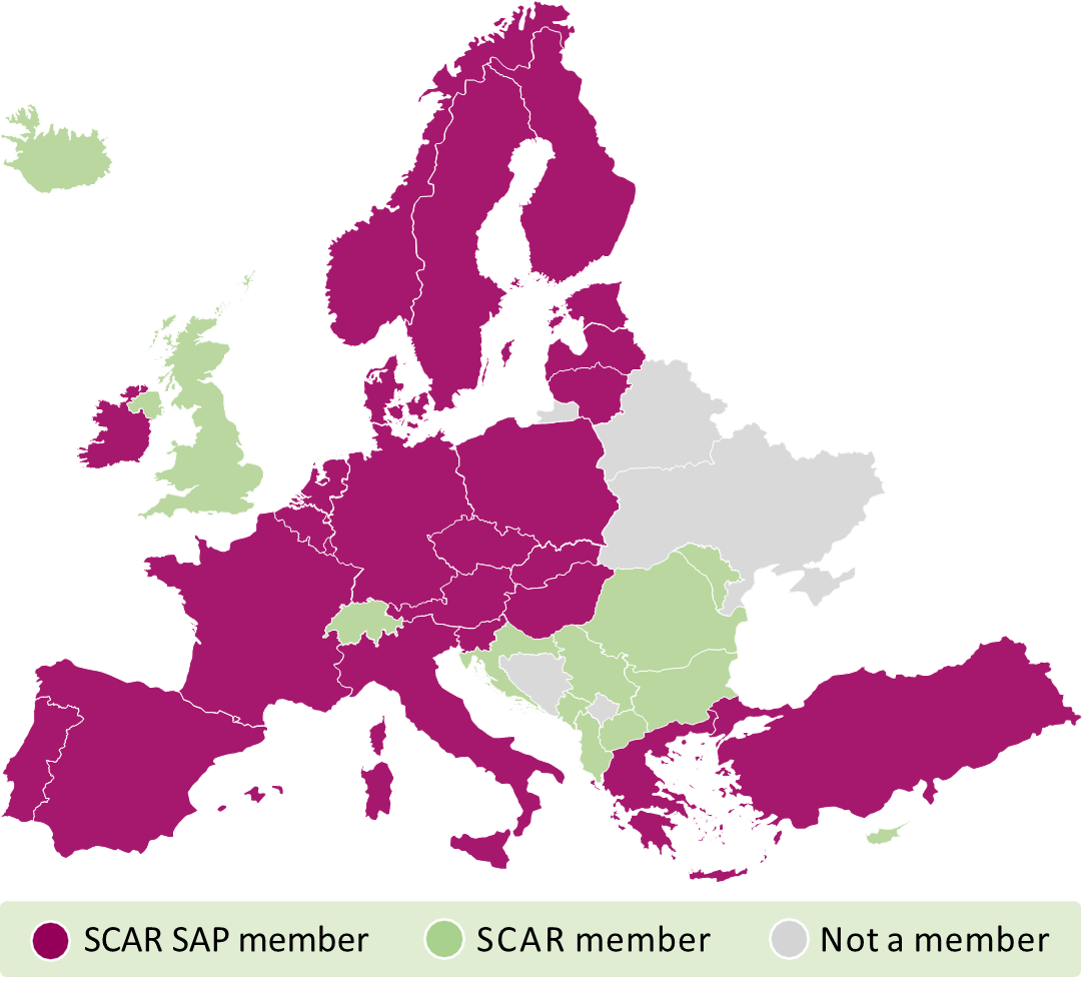
24 countries + EC and key advisors
The Standing Committee on Agricultural Research (SCAR) plays an important role in coupling research and innovation and in removing barriers to innovation. Since the renewal of SCAR in 2005, it initiated a number of WGs in a variety of areas, like the Working Group on Sustainable Animal Production (CWG SAP) in 2014.
The conditions for livestock farming are changing in several aspects, for instance, through climate change, Russia’s war on Ukraine, society’s expectations regarding animal husbandry, and producer income as well as consumer prices. These are complex challenges that cannot be met by limited ad hoc solutions, particularly not when considering Europe’s regional diversity. Instead, it requires enduring dedication and a focused strategy.
From its establishment in 2014, the CWG SAP has taken a systematic and coherent approach to contribute to the development of sustainable livestock production. A number of tasks were accomplished. Some were completed by establishing the ERA-NET SusAn, while others continued the coordination and alignment of national programs and elaborated and provided strategical advice to the European Commission and the Member States.
The SAP WG provides advice on the coordination of research and innovation for the development of more sustainable animal production systems in Europe to the SCAR, Member States, Associated Countries and to the European Commission.
Support of the livestock sector's important role has become particularly relevant in the light of unforeseen crises/shocks to the agri-food system, in combination with the need to design and pursue necessary long-term strategies.
The SAP WG mission is to provide and work with a holistic view on livestock farming and the livestock sector. This not only requires an integration of different research areas like animal nutrition, breeding and genetics, housing, and health & welfare. Also, it directly interrelates with topics like food and nutrition security and safety, resource utilisation, emissions (including GHG emissions), biodiversity, and farm economy.
This approach, which is based on systems thinking, characterises the SAP WG. At the same time, it demands exchange with initiatives working in related fields like animal health & welfare, food systems, agroecology and/or bioeconomy.
Last but not least, differences and commonalities between regions and stakeholders play an essential role in finding solutions for sustainable livestock production systems.
The scope of the SAP WG covers the entire production chain, with a main focus here on “pre-farm gate” activity, i.e., production of primary products (e.g. finished livestock, milk and eggs), on-farm management and husbandry interventions that have impacts either up- or down-stream of the entire supply chain (e.g. land use change, product quality, processing costs, waste, and consumer behaviour). The scope of the SAP WG also includes a perspective that lies outside the on-farm system, i.e. beyond farm gate. This covers areas like the role of livestock in circular agri-food systems or the contribution of livestock to ecosystem services.
The scope of SAP WG includes all major terrestrial species like beef and dairy cattle, sheep, goats, pigs and poultry and other livestock like rabbits, reindeer, farmed game and bees, but does not include fish and other aquaculture species, and also not animals that are bred and raised on fur farms, like fox, mink or chinchilla.
Even though feed production is an essential component of sustainable animal production systems, the disciplinary agronomic aspects of crop and forage production are outside the scope.
The Working Group will build on the previous steps taken, particularly the 2015 country report, the 2019 analysis on drivers of change, the recent successful finalisation of the ERA-NET SusAn in 2022, including its SRIA, and the 2022, 2023 and 2024 expert workshops on a common future vision.
The following main objectives shall be tackled during the next mandate:
Support investment in research & innovation:
The Working Group’s perspective is that both, Research & Innovation and public policy have strongly contributed to the development of Europe’s livestock sector. Members of SAP WG believe, that both factors will continue to play a major role also in the future.
(2025-2026)
27 November 2024
Workshop report
5 - 6 November 2024
Workshop report
30 Nov. / 1 Dec. 2023
– Meta Analysis as basis for future scenario building
June 2023
SCAR Sustainable Animal Production WG convenes in Denmark!
 The SCAR Sustainable Animal Production group hosted a highly productive and engaging workshop at Aarhus University in Denmark on 17-18th December 2025, focused on key developments in sustainable agri-food and livestock systems.
The packed agenda featured a wide range of insightful updates and presentations, including Policy updates from the European Commission, an update on the RefreSCAR study on the sustainability of livestock farming systems, updates from the SCAR Food Systems, AHW and Agroecology WG Chairs, presentations on Denmark’s Green Tripartite and much more. A trip to Foulum Research Centre followed the workshop, where members got an overview of their biorefinery, livestock and biogas research. The next SAP workshop is scheduled for Dublin, Ireland from 29-30th September.
| 29 Sep 2026; 12:00AM Workshop on ruminants and greenhouse gases |
| 28 May 2026; 12:00AM SCAR Sustainable Animal Production meeting |
| 17 Dec 2025; 12:00AM 2nd General Meeting |