Europe’s bioeconomy is increasingly challenged by overlapping and mutually reinforcing crises - including supply chain disruptions, ecological stress, geopolitical shocks, market volatility and governance constraints. These pressures do not occur in isolation; they interact in complex ways that can amplify vulnerabilities across sectors and regions. Yet, current policy frameworks, data infrastructures, and research agendas remain largely geared toward addressing single issues in a reactive and compartmentalised manner.
Strengthening the resilience of Europe’s bioeconomy requires a more integrated and forward‑looking approach—one that captures the dynamics between multiple crisis drivers and anticipates their combined effects.
This workshop provides a collaborative space to identify where critical knowledge gaps persist, where coordination among actors or systems falters, and which research and innovation pathways could most effectively enhance the resilience of bioeconomy systems in a context of poly‑crisis.
The objective is to identify research gaps and missing knowledge or solutions that currently limit effective crisis preparedness and response in the bioeconomy. The focus is on issues that can realistically be addressed through research, innovation and system design, rather than on short-term crisis management measures.
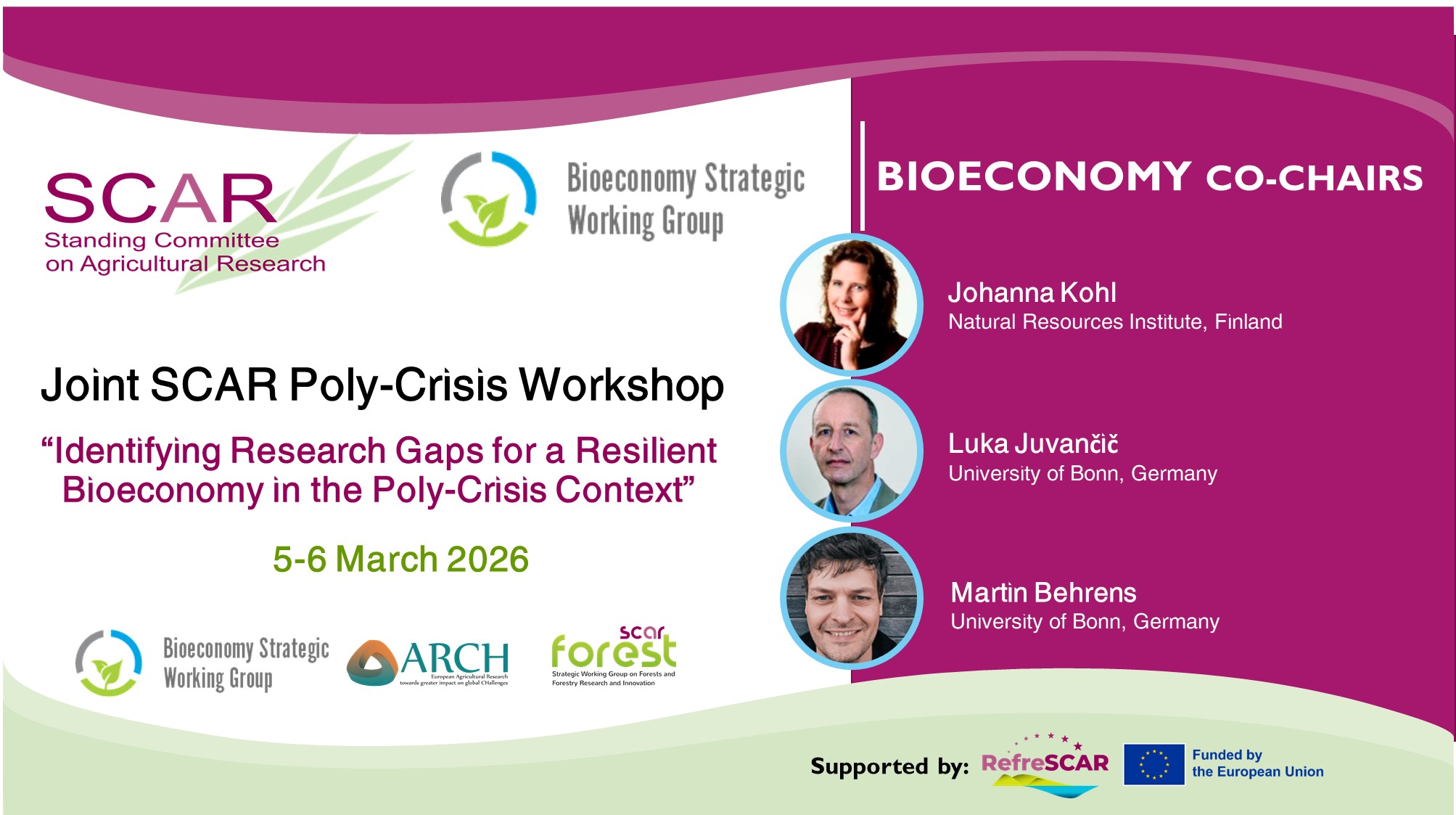
The workshop is exploratory and forward-looking. It has been initiated by SCAR Bioeconomy Working Group and supported by other Working groups, most notably SCAR ARCH and SCAR Forestry. The workshop is not a policy negotiation and not a project meeting.
To avoid abstract debate, discussions are anchored in three illustrative crisis scenarios. These scenarios are not predictions, but realistic stress tests for current bioeconomy systems.
1. Pest / Plant Health Crisis
A rapidly spreading pest or pathogen affects a key crop or tree species across several regions. Monitoring data is fragmented, response measures differ between countries, and advisory systems provide inconsistent guidance. Yield losses increase while trust in decision-making declines.
2. Security Crisis (Geopolitical Shock)
A geopolitical conflict disrupts trade routes and energy imports. Input prices (fuel, fertiliser, feed, materials) rise sharply. Regions dependent on imports face acute bottlenecks, while institutional coordination struggles to keep pace.
3. Value Chain Disruption
A major bio-based value chain (e.g. wood construction, food or feed production) faces a sudden and severe reduction in raw material availability due to extreme weather, volatile markets and logistics failures. Downstream actors prioritise large contracts, while smaller producers and local processors struggle. Public procurement is affected.